





 Email this article
  At-Talim Visitors Statistic
The Use Of Dictogloss Technique In Teaching Student’s Listening Skill
Abstract
Full Text:
PDFReferences
REFERENCES
Brown. H. Douglas, Language Assessment: Principle and Classroom Practices, (New York: Longman), 2004 247
Brown. H. Douglas, Teaching by Principles: An interactive approach to language pedagogy (second editon). (San Fransisco. Pearson Education Company.), 2001, 247
Ellis in Vasiljevic Zorana., Dictogloss as an Interactive Method of Teaching Listening Comprehension to L2 learners, English Language Teaching Vol 3 [Online Journal]. Retrieved on December 15, 2014 from http://www.ccsenet.org/elt.html
Fayza Saleh Hammadi, The Effectiveness of Using a Multi-media Software in Developing Some Listening Skills Among Saudi Secondary School Students. Damascus University Journal, Vol.27. (2011)
George Jacob and John Small, Combining Dictogloss and Cooperative Learning to Promote Language Learning, The Reading Matrix 3, No. 1, 2003, p.1
Harmer, Jeremy, How to teach English (England: Person Education Limited), 2007, 135
Kaplan in Valjevic Zorana, Dictogloss as an Interactive Method of Teaching Listening Comprehension to L2 learners, English Language Teaching Vol 3 [Online Journal], Retrieved on December 15, 2014 from http://www.ccsenet.org/elt.html
Nunan, Listening in Language Learning, The language teacher Online. Retrieved on Desember 15, 2014 from http://jalt-publications.org/tlt/files/97/sep/nunan.html. (2003), 2004
Nunan, D, Listening in Language Learning, The language teacher Online, Retrieved on Desember 15, 2014 from http://jalt-publications.org/tlt/files/97/sep/nunan, 24.
VasilJevic, Zorana, Dictogloss as an Interactive Method of Teaching Listening Comprehension to L2 learners, English Language Teaching Vol 3 [Online Journal], Retrieved on December 15, 2014 from http://www.ccsenet.org/elt.html
Wills & Wills in Vasiljevic Zorana, Dictogloss as an Interactive Method of Teaching Listening Comprehension to L2 learners, English Language Teaching Vol 3 [Online Journal]. Retrieved on December 15, 2014 from http://www.ccsenet.org/elt.html
DOI: http://dx.doi.org/10.29300/attalim.v15i1.291
Refbacks
- There are currently no refbacks.
Copyright (c) 2017 Syamsul Rizal, Vera Fitria

This work is licensed under a Creative Commons Attribution-NonCommercial-ShareAlike 4.0 International License.
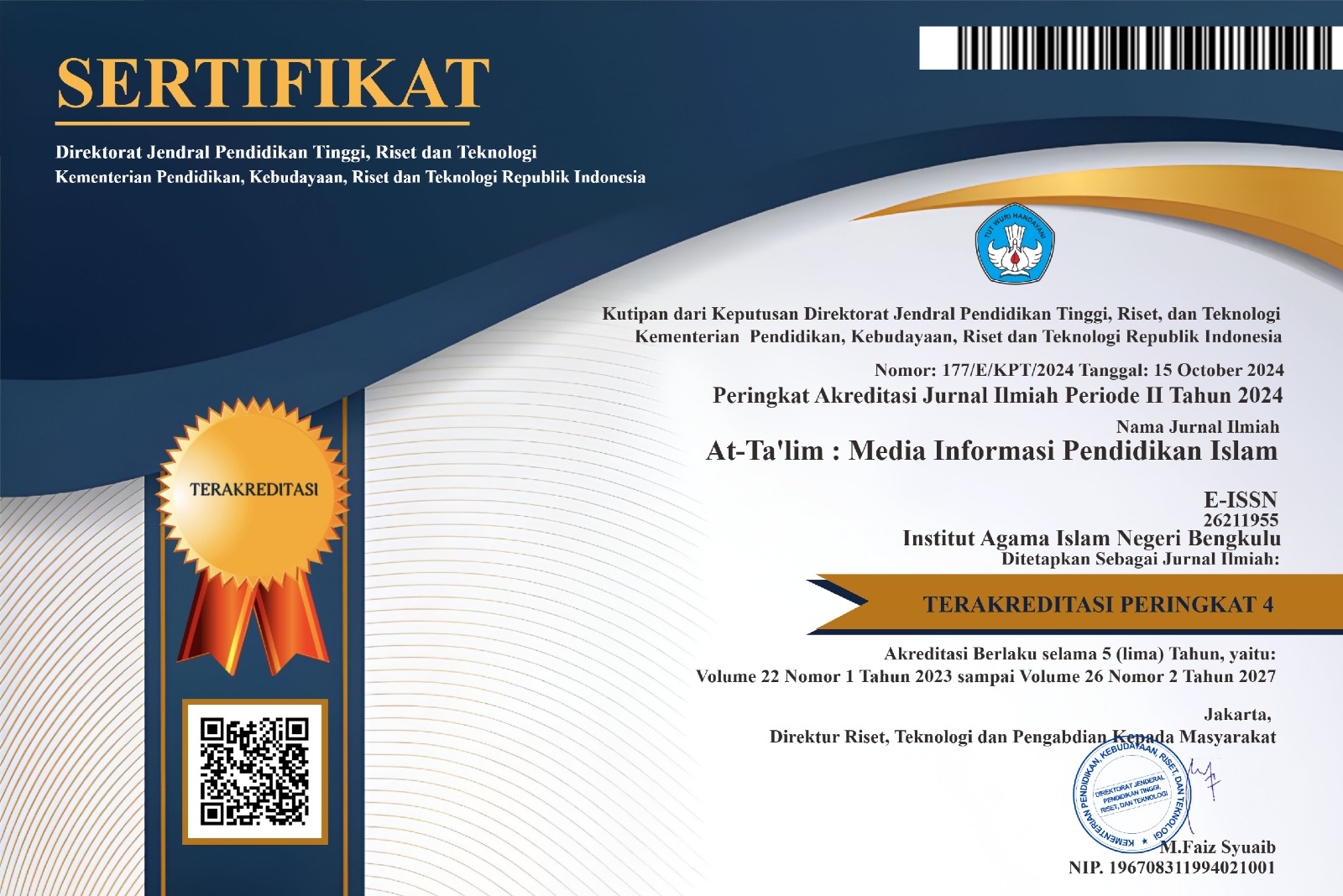
Thank you, the journal editorial team appreciates your visit to the At-Ta'lim : Media Informasi Pendidikan Islam. Think that working together will help to advance the pace of global knowledge generation and exchange. We are confident that publications in Attalim journal will contribute to the existing knowledge base, and novelty and stimulate further research in the field of islamic education. We greatly appreciate your contributions and look forward to working with you through this journal.
License Term:  At-Ta'lim : Media Informasi Pendidikan Islam by Pusat Publikasi Ilmiah Universitas Islam Negeri Fatmawati Sukarno Bengkulu is licensed under a Creative Commons Attribution-NonCommercial-ShareAlike 4.0 International License. You are free to: Share - copy and redistribute the material in any medium or format; Adapt - remix, transform, and build upon the material; The licensor cannot revoke these freedoms as long as you follow the license terms. Under the following terms: Attribution - You must give appropriate credit , provide a link to the license, and indicate if changes were made . You may do so in any reasonable manner, but not in any way that suggests the licensor endorses you or your use. NonCommercial - You may not use the material for commercial purposes. ShareAlike - If you remix, transform, or build upon the material, you must distribute your contributions under the same license as the original. No additional restrictions - You may not apply legal terms or technological measures that legally restrict others from doing anything the license permits. |
LPPM, Pusat Publikasi Ilmiah, Universitas Islam Negeri Fatmawati Sukarno Bengkulu, Indonesia